
Education technology has a familiar rhythm.
A new tool arrives with bold promises. Headlines buzz. Pilot programs launch. A few years later, the excitement fades and schools quietly move on, wiser and more cautious.
Not every innovation follows that arc.
Immersive learning stands apart because it is not built around novelty. It is built around how humans naturally learn.
EdTech Trends Come and Go. Learning Science Endures.
Many short-lived edtech tools share the same flaw. They focus on delivery rather than understanding.
Digital worksheets replaced paper ones. Videos replaced lectures. Dashboards replaced gradebooks. While these tools may improve efficiency, they rarely change how deeply students understand what they are learning.
Immersive learning does something different. It places students inside the concept.
Instead of reading about ancient civilizations, students stand in them. Instead of memorizing scientific processes, they observe and manipulate them in real time. Instead of passively consuming information, they interact with it.
That distinction is why immersive learning has staying power.
Immersion Mirrors How the Brain Learns Best
Decades of cognitive research tell us that learning sticks when multiple senses are engaged and when students can connect abstract ideas to concrete experiences.
Immersive learning naturally supports this by:
-
Activating spatial memory, which strengthens recall
-
Encouraging curiosity through exploration rather than instruction alone
-
Providing context that makes complex ideas easier to grasp
-
Allowing students to learn by doing, not just listening
This is not a trend driven by technology. It is a response to human cognition.
When students can experience a concept, understanding deepens and retention follows.
Immersive Learning Is Flexible, Not Fragile
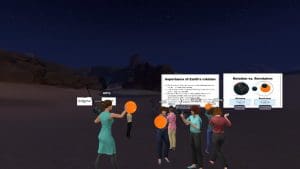 Many edtech tools struggle to adapt across grade levels, learning styles, or subject areas. Immersive learning thrives precisely because it is versatile.
A virtual environment can support:
-
Elementary students building foundational understanding
-
Middle school students exploring cause and effect
-
High school students engaging in advanced analysis and discussion
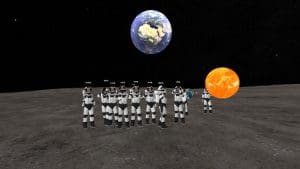 It works for humanities, sciences, math, and language learning. It supports collaborative learning and independent exploration. It scales without losing impact.
Trends fade when they are narrow. Immersion endures because it is expansive.
It Enhances Teachers, It Does Not Replace Them
One reason immersive learning continues to gain trust is that it does not position technology as the teacher.
Instead, it amplifies great teaching.
Educators guide discussion, frame exploration, ask deeper questions, and help students reflect on what they experienced. Immersion becomes the environment where learning happens, not the voice that replaces human connection.
At Optima, immersive learning is intentionally integrated into a teacher-led, values-centered educational model. Technology supports the lesson rather than steering it.
That balance is essential for longevity.
Immersive Learning Aligns With Real-World Skills
 The future demands more than memorization.
Students need to analyze information, adapt to new environments, collaborate across distances, and apply knowledge in unfamiliar contexts. Immersive learning cultivates these skills naturally.
By navigating complex environments, making decisions, and reflecting on outcomes, students practice the same cognitive flexibility they will need beyond the classroom.
When learning mirrors life, it remains relevant.
Why Immersion Is Here to Stay
Edtech trends often chase what is new. Immersive learning succeeds because it reconnects education to something timeless: experience.
It respects how students learn. It supports how teachers teach. It prepares learners for a world that values understanding over repetition.
At Optima, immersive learning is not a moment. It is a methodology.
And methodologies grounded in human learning do not fade. They evolve.





Leave A Comment