
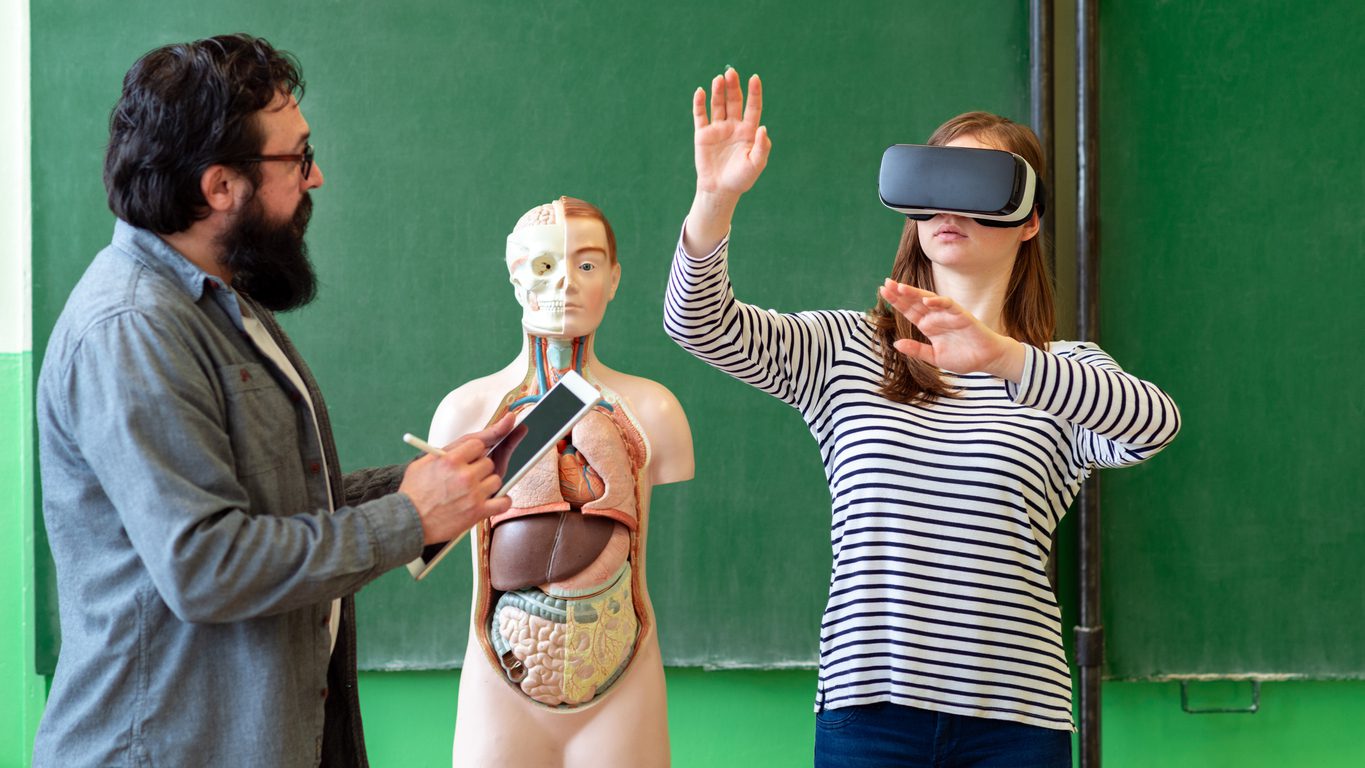
Over the past decade, online learning has transformed education. It expanded access, introduced flexibility, and brought classrooms beyond physical walls. But as technology evolves, a new model is emerging. One that does not just deliver content, but places students inside it.
That model is immersive learning.
While the terms are sometimes used interchangeably, online learning and immersive learning are fundamentally different in how students experience, process, and retain information. For school leaders evaluating the next phase of digital learning, understanding that difference is critical.
Defining the Two Models
Online Learning: Access and Delivery
Online learning refers to instruction delivered through digital platforms, typically via video lessons, assignments, and virtual discussions.
Students:
-
Watch lectures or recorded instruction
-
Complete coursework on a device
-
Engage through discussion boards or live video calls
This model prioritizes accessibility and scalability, making it possible to reach students anywhere.
At its core, online learning often replicates traditional instruction in a digital format. The student remains an observer.
Immersive Learning: Experience and Interaction
Immersive learning uses technologies like virtual reality (VR), augmented reality (AR), and 3D simulations to place students directly inside the learning environment.
Students:
-
Walk through ancient civilizations instead of reading about them
-
Manipulate molecules instead of viewing diagrams
-
Practice real-world scenarios in safe, controlled environments
This model prioritizes experience, interaction, and presence. The student becomes an active participant.
The Core Difference: Consumption vs. Participation
At the heart of the distinction is a simple shift:
-
Online learning delivers information
-
Immersive learning creates experiences
In a traditional online lesson, a student might watch a video about the Roman Forum.
In an immersive environment, that same student can stand in the Forum, observe its scale, and explore its architecture firsthand.
The content may be similar. The cognitive impact is not.
Why It Matters: Engagement and Retention
Research consistently shows that students retain more when they actively engage with material rather than passively consume it.
Immersive learning introduces key drivers of deeper learning:
-
Spatial understanding. Students grasp complex concepts by seeing and interacting in 3D space
-
Emotional connection. Experiences create memorable learning moments
-
Active participation. Learners make decisions, explore, and discover
Online learning can engage. Immersive learning anchors that engagement in experience.
The Teacher’s Role: From Presenter to Guide
One common misconception is that immersive technology replaces teachers. In practice, it does the opposite.
In online learning environments, teachers often act as presenters of information.
In immersive environments, teachers become:
-
Facilitators of exploration
-
Guides for discussion and reflection
-
Connectors between experience and academic concepts
The technology handles visualization. The teacher drives meaning.
Where Online Learning Still Excels
This is not a zero sum comparison.
Online learning remains highly effective for:
-
Foundational instruction
-
Flexible scheduling
-
Scalable course delivery
-
Independent practice and reinforcement
It provides the structure and accessibility that modern education depends on.
Where Immersive Learning Elevates Outcomes
Immersive learning shines when depth of understanding matters most:
-
Complex scientific concepts
-
Historical context and empathy building
-
Career and technical education (CTE) simulations
-
Situations that are dangerous, expensive, or impossible to replicate in real life
It transforms abstract ideas into tangible experiences.
The Future Is Not Either or
The most effective schools are not choosing between online and immersive learning. They are integrating both.
Online learning provides the framework.
Immersive learning provides the dimension.
Together, they create a model where:
-
Students learn foundational knowledge online
-
Then apply and experience that knowledge immersively
This blended approach moves education beyond content delivery and toward true understanding.
A Strategic Opportunity for Schools
For district leaders and administrators, the shift toward immersive learning represents more than a technology upgrade. It is a strategic opportunity to:
-
Differentiate instructional offerings
-
Increase student engagement
-
Improve retention of complex material
-
Prepare students for a more interactive, technology driven world
Schools that embrace immersive learning are not just adopting new tools. They are redefining how learning happens.








Leave A Comment