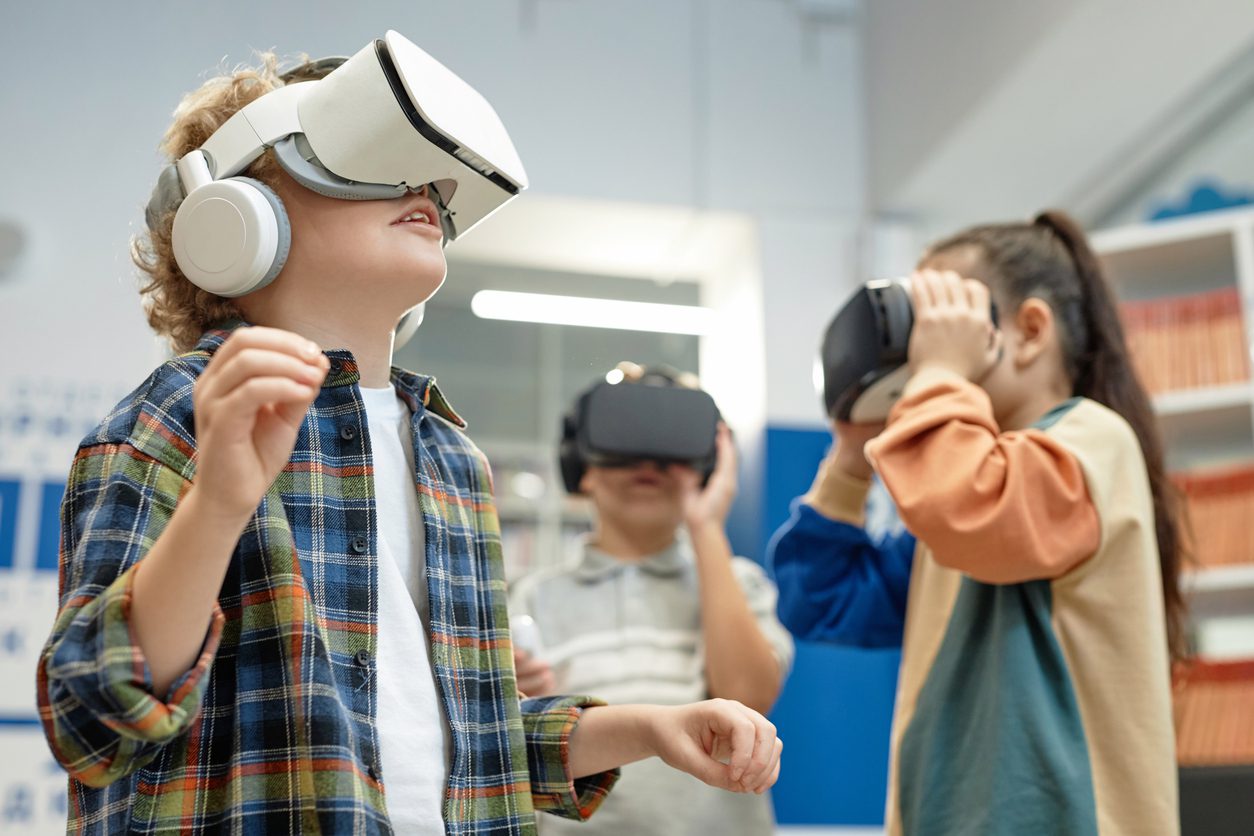

Immersive learning is no longer a futuristic “nice-to-have.” It’s already reshaping what’s possible in real classrooms today.
Across the country, educators are using virtual reality and spatial learning tools to help students explore complex concepts, connect more deeply with content, and engage in richer learning experiences, whether they’re studying ancient civilizations, walking through a science lab, or practicing career-ready skills.
At Optima, we’ve seen firsthand that immersive learning isn’t about replacing teachers or traditional instruction. It’s about expanding what learning can feel like.
Below are 10 real classroom use cases for immersive learning, grounded in the ways schools are using VR right now.
1. Experiencing History Instead of Memorizing It
History becomes more meaningful when students can step inside it.
Instead of simply reading about the Cold War or Ancient Rome, students can explore immersive environments that spark discussion, perspective-taking, and deeper retention.
Classroom impact:
-
Stronger engagement with primary themes
-
Richer student dialogue
-
Improved long-term recall
2. Exploring Science Through Virtual Labs
 Immersive learning allows students to interact with scientific environments that may be inaccessible in a traditional classroom.
From biology simulations to environmental science exploration, VR supports inquiry-based learning in a safe and dynamic way.
Use case examples:
-
Studying ecosystems firsthand
-
Observing limiting factors in photosynthesis
-
Connecting respiration and cellular processes visually
3. Bringing Literature to Life Through Setting and Symbolism
Immersive learning isn’t just for STEM.
English classrooms are using VR to help students explore the worlds of novels, analyze symbolism, and engage more deeply with character development.
Imagine studying Frankenstein while exploring a recreated lab environment that reinforces themes of nature vs. nurture.
Outcome:
Students move from passive reading to active interpretation.
4. Supporting Deeper Geography and Cultural Understanding
Geography is more than maps, it’s lived experience.
Students can explore landforms, cultural landmarks, and regions tied directly to their coursework, building empathy and context along the way.
Best for:
-
World history
-
Cultural studies
-
Global citizenship education
5. Enhancing Religious and Classical Studies
Immersive learning can help students visualize sacred sites and historical landscapes connected to religious instruction.
For example, students studying the Promised Land can explore the environment while reflecting on symbolism, scripture, and historical context.
Why it works:
Immersion creates emotional connection, which strengthens comprehension.
6. Strengthening Language Learning Through Context
 Language becomes more natural when students can practice it in realistic settings.
Immersive environments allow students to “travel” to markets, cities, and cultural spaces where vocabulary and conversation feel purposeful.
Benefits:
-
Increased confidence
-
Better pronunciation practice
-
More authentic cultural learning
7. Teaching Math Through Interactive Spatial Manipulatives
 Immersive learning supports hands-on math instruction in a way worksheets can’t.
Students can interact with 3D manipulatives, visualize geometry, or engage in applied problem-solving inside a virtual space.
This is especially impactful for learners who benefit from spatial reasoning support.
8. Career Exploration and Workforce Readiness
One of the most exciting applications of immersive learning is career exposure.
Students can explore future pathways through simulations and role-based environments, even if local opportunities are limited.
Examples include:
-
Healthcare environments
-
Engineering spaces
-
Hospitality and culinary settings
9. Building Communication and Collaboration Through Shared Virtual Spaces
Immersive environments give students opportunities to collaborate in real time, share ideas, and participate more actively in group learning experiences.
For some learners, virtual spaces can reduce hesitation and encourage stronger classroom participation.
Common outcomes:
-
Greater student voice
-
More inclusive engagement
-
Stronger peer collaboration
10. Project-Based Learning and Student Creation
The most powerful immersive learning isn’t just consuming experiences, it’s creating them.
Students can design worlds, build scenes tied to coursework, and explore “what if” questions through spatial storytelling.
This transforms students from learners into makers.
Skills developed:
-
Creativity
-
Critical thinking
-
Digital literacy
-
Communication
Immersive Learning Isn’t a Trend, It’s a Tool for Deeper Learning
Immersive learning works best when it supports what great teachers already do: spark curiosity, deepen understanding, and connect students to ideas that matter.
The classrooms embracing VR today aren’t chasing novelty. They’re unlocking new ways to engage learners, reach diverse needs, and make education unforgettable.
At Optima, we believe immersive learning is one of the most meaningful shifts in modern education, not because it’s flashy, but because it makes learning real.

Bridgette Hudak