

Science has always been about curiosity, experimentation, and discovery. But traditional labs often come with significant barriers — high equipment costs, limited access, safety concerns, and logistical constraints. Virtual reality (VR) is changing that. With VR Labs, schools can offer immersive, hands-on science experiences that feel real, without the mess, cost, or risk.
The Challenge with Traditional Labs
For many schools, especially those in rural or underfunded districts, building and maintaining a full science lab is nearly impossible. Chemicals, microscopes, and safety equipment are expensive to buy and replace. Students can only perform certain experiments under strict supervision or not at all due to safety hazards. Even when resources exist, students may only get one chance to perform an experiment before supplies run out.
These limitations mean fewer opportunities for students to explore science through active experimentation — the kind that fosters true understanding and long-term retention.
A New Era of Exploration Through VR Labs
Virtual reality offers a groundbreaking solution. In VR Labs, students don’t just watch science happen — they do it. They can dissect a frog, mix volatile chemicals, or explore the inside of a human cell — all in a safe, reusable, and cost-effective environment.
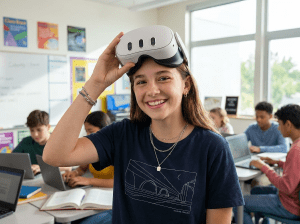 Students can:
-
Conduct chemistry experiments without chemical waste or danger.
-
Explore the anatomy of organisms in full 3D immersion.
-
Manipulate molecules, planets, or energy fields with their own hands.
-
Repeat experiments as many times as needed to master a concept.
Through these experiences, complex concepts become tangible. Learning becomes an adventure, and curiosity becomes the driving force behind every lesson.
Safety Meets Unlimited Opportunity
VR Labs eliminate the risks associated with live experiments, no burns, spills, or broken glass. Students can safely push boundaries, test hypotheses, and even make mistakes without consequence. These environments allow for the kind of fearless learning that real labs often can’t support.
This also opens science education to a broader range of students, including those with sensory sensitivities, physical disabilities, or anxiety around high-stakes lab environments. With VR, every student has a front-row seat to discovery.
Affordability and Accessibility for Schools
 Investing in physical labs requires ongoing costs for materials, safety equipment, and maintenance. In contrast, VR Labs require only headsets and digital licenses — a one-time investment that can serve hundreds of students for years. Schools can reallocate budgets from consumables to expanding their digital content libraries, ensuring ongoing innovation and enrichment.
With OptimaEd’s VR content library — featuring more than 200 immersive environments and 5,000 interactive 3D models — teachers can bring a world of science into any classroom. From virtual physics experiments to cellular biology walkthroughs, the possibilities are endless.
Teachers as Guides, Not Technicians
Rather than worrying about lab setup, cleanup, or safety compliance, teachers can focus on what matters most: guiding inquiry and deepening understanding. VR empowers teachers to facilitate meaningful discussions, ask probing questions, and connect experiments to larger scientific principles. The technology becomes the tool — not the focus.
The Future of Science Education Is Virtual
VR Labs represent more than a digital upgrade; they’re a paradigm shift. They level the playing field for schools of all sizes, remove barriers to exploration, and make science accessible, engaging, and safe for every learner.
In a world where innovation drives progress, VR Labs prepare the next generation of scientists not just to understand the world — but to experiment, explore, and change it.





Leave A Comment