
In today’s competitive education landscape, enrollment is no longer driven by proximity alone. Families and students are making more intentional choices, evaluating not just what is taught, but how learning is experienced.
At the center of this shift is the classroom itself.
Innovative classrooms are no longer a “nice to have.” They are becoming a defining factor in how schools attract, engage, and retain students. For school leaders, this represents both a challenge and an opportunity: rethinking the learning environment as a strategic driver of enrollment growth.
The Modern Enrollment Mindset
Today’s families approach school selection with a consumer mindset. They are comparing options, researching outcomes, and looking for clear differentiation.
What stands out?
- Evidence of student engagement
- Clear alignment between curriculum and real-world application
- Learning environments that feel dynamic, not passive
A traditional classroom model, even with strong academics, can struggle to communicate these qualities at first glance. In contrast, innovative classrooms make the learning experience visible, tangible, and compelling.
They answer a key question for prospective families: Will my child be engaged here?
Innovation as a Signal of Quality
Innovation in the classroom serves as a powerful signal. It communicates that a school is forward-thinking, adaptable, and invested in student success.
This does not mean abandoning foundational approaches. In fact, the most effective models combine time-tested academic frameworks with modern delivery methods.
For example, a classically aligned curriculum paired with immersive technology allows students to move beyond memorization into deeper understanding. When students can step into historical events, explore scientific concepts spatially, or interact with complex systems in real time, learning becomes active rather than abstract.
For families observing from the outside, this shift is immediately recognizable.
It signals rigor, relevance, and intentionality.
The Role of Immersive Learning Environments
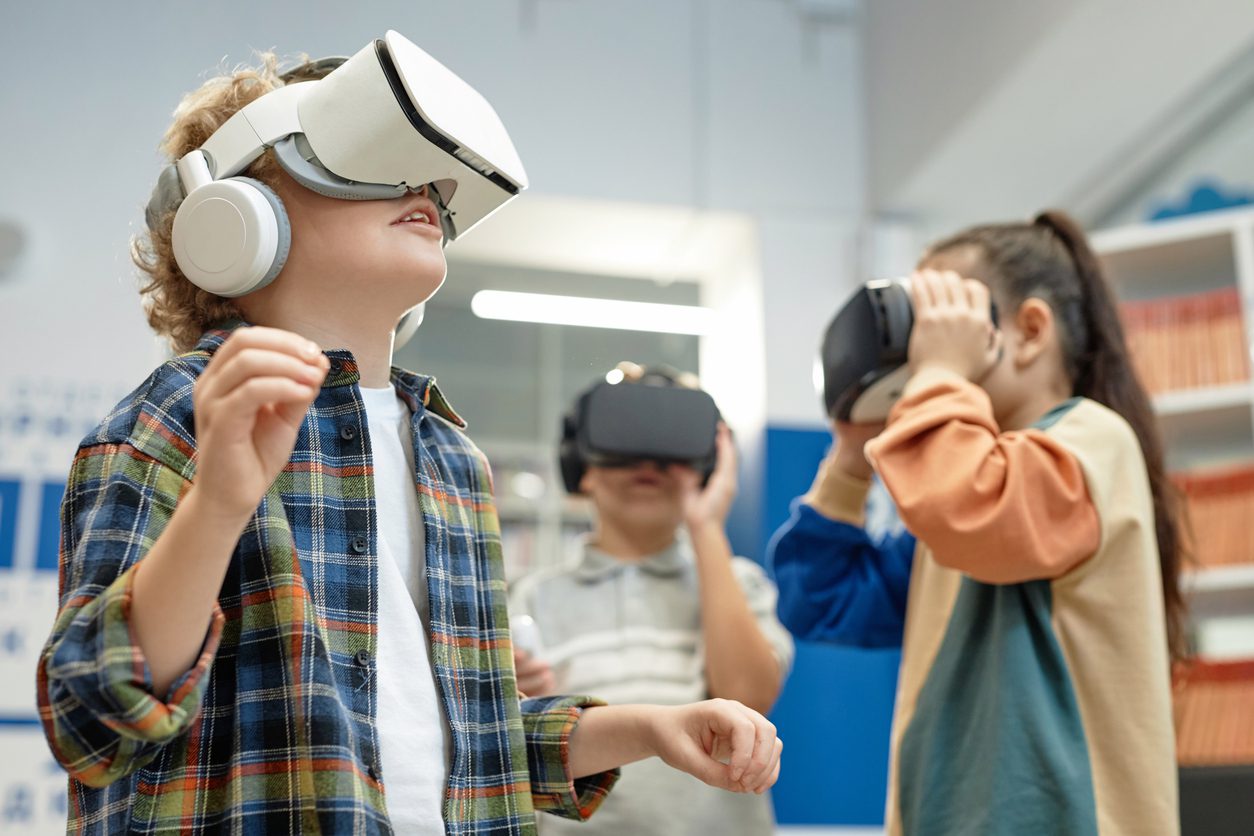
Immersive learning environments, including virtual reality, are redefining what a classroom can be.
Rather than limiting learning to textbooks or lectures, these environments place students inside the lesson itself. A history class becomes a lived experience. A science concept becomes something students can manipulate and explore.
This approach has two important enrollment implications:
1. It differentiates the school in a crowded market
Schools that integrate immersive learning stand apart. The experience is difficult to replicate and easy to remember, which strengthens both initial interest and long-term brand recall.
2. It builds confidence for families
Parents are not just looking for innovation. They are looking for outcomes. When immersive tools are used intentionally, alongside strong instruction, they demonstrate a commitment to deeper comprehension and student engagement.
The result is a clearer value proposition.
From Engagement to Enrollment
Engagement is not just a classroom outcome. It is a marketing advantage.
Prospective families are highly attuned to whether students are participating actively or passively. When they see students leading discussions, interacting with content, and demonstrating curiosity, it builds trust.
Innovative classrooms create moments that are easy to showcase:
- A student presenting from within a virtual environment
- A class collaboratively solving problems in real time
- A lesson that connects abstract concepts to lived experience
These moments translate naturally into enrollment content, whether through campus tours, social media, or admissions conversations.
They provide proof.
Aligning Innovation with Institutional Identity
While innovation is powerful, it is most effective when it aligns with a school’s core identity.
For many institutions, this means integrating modern tools within a broader educational philosophy rather than replacing it.
A classical school, for example, may use immersive technology to deepen engagement with great books, historical events, or philosophical ideas. The foundation remains intact, but the delivery evolves.
This balance is what resonates with families.
They are not looking for novelty. They are looking for thoughtful progress.
A Strategic Imperative for School Leaders
Enrollment trends are increasingly shaped by perception as much as performance. Innovative classrooms influence both.
They shape how a school is experienced by students and how it is perceived by prospective families.
For school leaders, the question is no longer whether innovation matters, but how it is implemented:
- Is it aligned with the school’s mission?
- Does it enhance, rather than distract from, instruction?
- Can it be clearly communicated to families?
When the answer to these questions is yes, innovation becomes more than a classroom enhancement.
It becomes a growth strategy.
The Future of Enrollment is Experiential
As expectations continue to evolve, schools that create visible, engaging, and meaningful learning experiences will have a clear advantage.
Innovative classrooms do more than improve instruction. They tell a story.
A story of a school that is preparing students not just to succeed academically, but to think critically, engage deeply, and navigate a complex world.
For families making one of the most important decisions for their children, that story matters.

Bridgette Hudak