

Ask any educator what skill they most want graduates to carry into adult life, and “critical thinking” tops the list. It always has. The difference today is urgency.
Artificial intelligence tools can now draft essays, solve equations, generate lesson plans, write code, and summarize entire textbooks in seconds. For school leaders and educators navigating this new terrain, that capability raises a harder question than most technology ever has: if a machine can produce the output, what exactly are we teaching scholars to do?
The answer is not to ban AI from classrooms. The answer is to double down on the one cognitive capability AI cannot replicate: the human capacity to evaluate, question, contextualize, and judge.
“AI makes critical thinking more necessary, not less. Fluency without judgment is just noise at scale.”
The Automation Paradox in Education
Technology has always automated lower-order tasks, freeing humans to focus on higher-order ones. The calculator did not kill mathematics; it ended the career of the person whose only skill was arithmetic. Word processing did not eliminate writers; it ended the career of the person whose only skill was legible handwriting.
Generative AI is doing the same thing, at a higher cognitive layer than we have ever seen. It automates the production of coherent, grammatically correct, logically structured text. That means the task being automated is no longer manual; it is compositional. For the first time, we are watching a machine handle a skill we previously considered exclusively human.
The implication for educators is clear: teaching scholars to produce content is no longer sufficient. The new imperative is teaching them to evaluate content, verify it, interrogate its assumptions, identify its blind spots, and make sound decisions based on imperfect information. That is, in one word, judgment.
What AI Cannot Do
Understanding the genuine limits of AI is not technophobia. It is intellectual honesty that every educator and school leader needs right now. Large language models are trained to predict the most statistically probable next token in a sequence. They excel at pattern recognition and synthesis across enormous datasets. They do not reason; they compute confidence.
That distinction matters enormously in practice. AI cannot:
- Recognize when a problem requires a framework that does not yet exist
- Detect ethical nuance or weigh competing values in a specific community context
- Know what it does not know, or flag the limits of its own training data
- Take accountability for the downstream impact of its outputs
- Adapt a strategy when real-world feedback contradicts the model
Every one of those gaps requires a human being who has been trained to think critically. Schools that treat AI as a shortcut are, without realizing it, producing scholars who are perfectly prepared to be supervised by a machine but not to lead, question, or innovate alongside one.
The Classical Roots of a Modern Skill
Critical thinking is not a new curriculum initiative. It is the oldest academic tradition in the Western canon. Socratic dialogue, the Trivium, Aristotelian logic, the Great Books approach: all of these are designed around one central practice. They ask scholars not to receive knowledge but to wrestle with it.
This is why classical education, long considered traditional, has become structurally forward-thinking. A curriculum built around primary texts, close reading, reasoned debate, and Socratic inquiry is training exactly the cognitive muscles that AI cannot replicate. The scholar who has spent years evaluating the arguments of Plato, analyzing the logic of Euclid, and writing original responses to difficult questions is not threatened by generative AI. That scholar knows how to use it, check it, and go further than it.
For school leaders considering curriculum design in an AI era, the data points in one direction: invest deeper in the liberal arts tradition. The returns are not sentimental; they are strategic.
Immersive Learning as a Critical Thinking Engine
Pedagogy matters as much as curriculum. Critical thinking is not a subject; it is a practice. Scholars develop it through repeated cycles of inquiry, hypothesis, experience, and reflection. That cycle requires environments that reward questions over correct answers and exploration over efficiency.
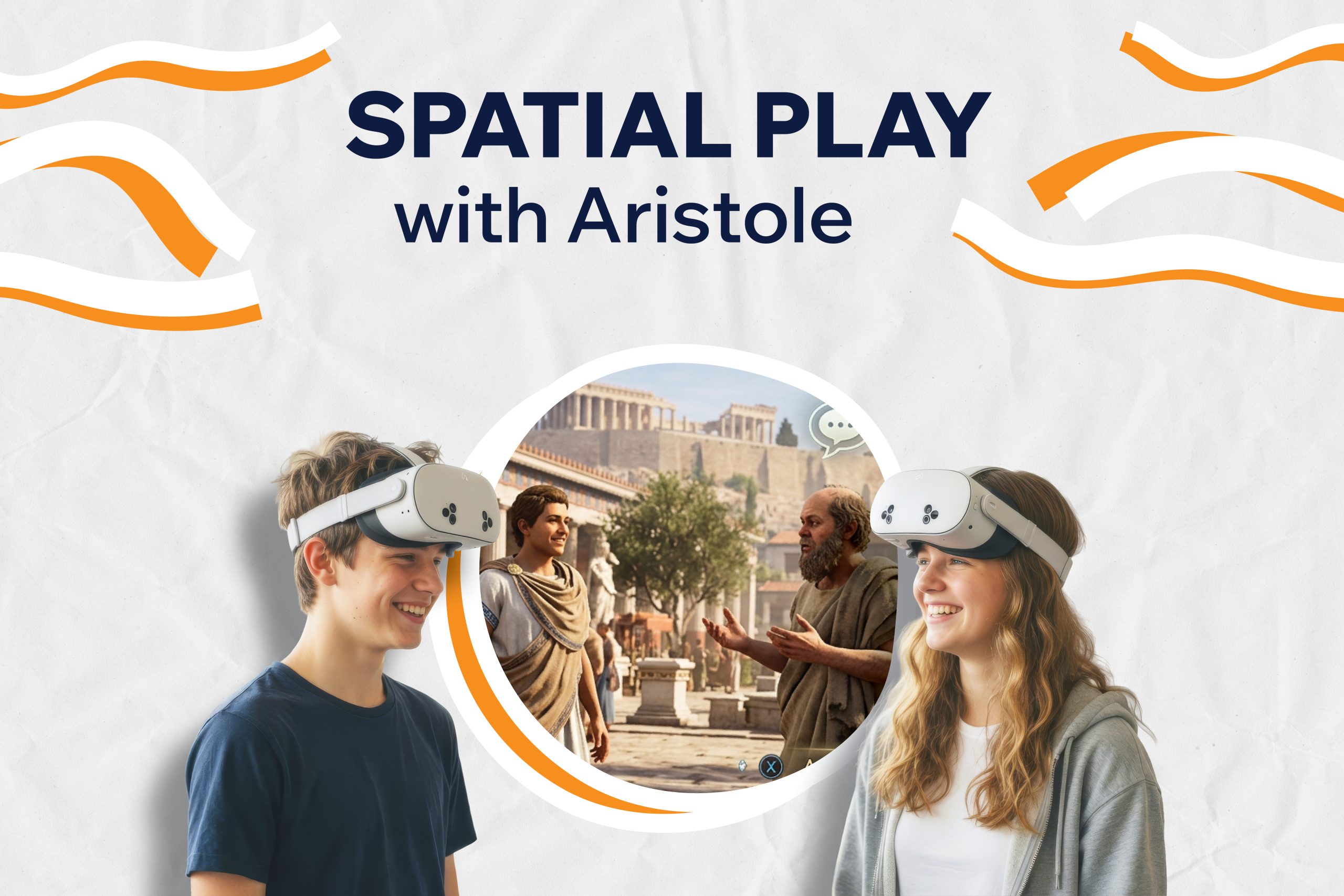
Immersive learning environments, including virtual reality, are particularly well-suited to building these habits. When a scholar steps inside a historical event, navigates a scientific phenomenon, or collaborates in a simulated environment, they are not consuming content. They are making decisions in context, observing consequences, revising assumptions, and constructing understanding from experience. That is the cognitive loop that produces critical thinkers.
Technology deployed this way does not replace critical thinking. It demands it. Scholars cannot coast through an immersive learning experience. There is no multiple-choice answer to what they encounter. The environment puts the scholar in the position of an agent rather than a recipient, which is precisely the posture that transfers to real-world problem-solving.
“The scholar who wrestles with great ideas is not threatened by AI. That scholar knows how to use it, check it, and go further than it.”
What This Means for School Leaders Right Now
The decisions made in the next few years about curriculum, technology integration, and instructional design will determine whether a generation of scholars emerges equipped to work alongside AI or vulnerable to being displaced by it. That is not hyperbole. It is the practical reality of the labor market these scholars are entering.
The practical playbook for school leaders looks like this:
- Audit where AI is reducing cognitive demand rather than enhancing it. If scholars are using AI to avoid thinking, the tool is producing learned helplessness, not efficiency.
- Prioritize assessment of process over product. If the deliverable can be AI-generated, the deliverable is not the right measurement. Ask scholars to explain their reasoning, defend their conclusions, and critique their own work.
- Invest in Socratic pedagogy. Structured discussion, debate, and collaborative inquiry are not soft skills. They are the primary training ground for judgment.
- Choose technology that amplifies human engagement. The right question about an EdTech platform is not whether it is efficient. The question is whether it puts scholars in an active, curious, problem-solving relationship with content.
- Treat AI literacy as a critical thinking discipline. Teaching scholars to prompt effectively, evaluate AI outputs, identify hallucinations, and understand model limitations is not a vocational skill. It is applied epistemology.
The Educator’s Role Has Never Mattered More
There is a version of the AI-in-education conversation that is deeply dispiriting for teachers: the version where AI replaces the instructor, grades the papers, and personalizes the content while the human in the room becomes a proctor. That is the wrong version, and it is wrong because it misunderstands what teaching is for.
Teaching has never been primarily about the transfer of information. It has always been about the formation of minds. The teacher who asks the question no AI would think to ask, who notices that a scholar is close to a breakthrough and knows when to push and when to wait, who models intellectual humility and genuine curiosity, that teacher is not competing with AI. That teacher is doing the irreplaceable work.
AI tools, used well, return time to educators. That time belongs in the classroom, in conversation, in the kind of relational instruction that turns information into wisdom. The schools that understand this distinction will produce graduates who are not just AI-literate but AI-proof.
The Bottom Line
Every major technological shift in history has reorganized the value of human skills, not eliminated them. AI is doing that now, faster and at a higher cognitive layer than anything before it. The skills that hold their value through this shift are the ones machines cannot compute: curiosity, judgment, ethical reasoning, creative synthesis, and the capacity to ask the right question.
Those are the skills a classical curriculum develops. Those are the habits an immersive learning environment builds. Those are the outcomes a great teacher produces.
The age of AI is not the age of the end of critical thinking. It is the age when critical thinking finally becomes the most measurable competitive advantage a scholar can have. Schools that build it systematically and deliberately will graduate the leaders, the innovators, and the problem-solvers the next era demands.
There is a better way to do school. It starts with the oldest idea in education: teaching scholars to think.




Leave A Comment